
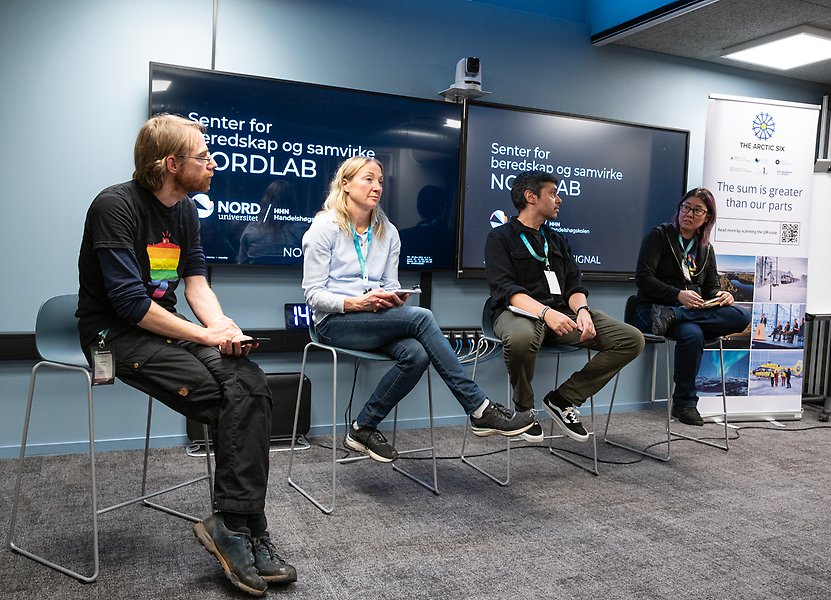
Arctic Six Chairs discussion: Stefan Prost from the University of Oulu, Christine Grosse from Luleå University of Technology, Pedro Sanches from Umeå University and Barbara Mizumo Tomotani from UiT - The Arctic University of Norway (Photo: Staffan Westerlund)
22 October 2026
Arctic Six Chairs map out stronger research collaboration across the alliance
From research insight to concrete action. That was the ambition when Arctic Six researchers gathered at the Arctic Six Annual Forum at Nord University in Bodø.
Over two days, participants discussed some of the Arctic’s most pressing challenges and explored new opportunities for collaboration.
This year’s Annual Forum placed particular emphasis on the new Arctic Six Chairs 2026–2028 and their role in strengthening research collaboration across the Arctic Six alliance.
The programme provided an opportunity to present and discuss Chair projects, explore possible links across institutions and disciplines, and identify opportunities for future collaboration.
“We are building relationships”
“Our main challenge that we are given as Arctic Six Chairs is to build knowledge through research projects, but we actually have to realise that, as Arctic Six Chairs we are not just building our projects, but we are building relationships and a foundation for future Arctic Six Chairs”, says Arctic Six Chair for 2025-2027, Professor Corine Wood-Donnelly, who hosted a session where former Chairs responded to challenges identified in research collaboration and reflected on how these can be addressed in practice.
“The challenge is to move beyond that narrow focus on our projects. This is really about capacity and expertise building”, she emphasises.
When asked about advice for future Arctic Six Chairs, Wood-Donnelly highlights the importance of a detailed action plan:
“The challenge will be different for everyone and will depend on where they are in their career and what other institutional responsibilities they might have. For me it would have been better if I could have protected my time better. Scheduling time for working on your project and mapping out a detailed action plan is important”.
A unified voice from experts
Arctic Six Coordinator for Nord University, Tina Bringslimark, highlights the important of a unified voice in addressing core Arctic challenges:
“The Arctic Six contributes actively to both policymaking and the broader research and innovation support system. Our voice carries much more weight when it comes from six universities acting together”, Bringslimark says.
“For example, we have provided input to the revising of the EU's Arctic policy. We have also submitted joint recommendations for the new Horizon Europe framework programme. In Norway, Arctic Six has received considerable attention. The Norwegian Minister of Foreign Affairs Espen Barth Eide has referred to the alliance in his speeches when visiting the region, and Arctic Six has also been mentioned by the European Commission in official speeches. As a result, we have a strong position both politically and in terms of influencing the funding landscape and policy instruments that determine which research initiatives can receive support. That makes Arctic Six a highly important collaboration”, Bringslimark highlights.
Leader of the Research working group, Keith Larson adds:
“We are not only researching in this region, but we’re also citizens here. We have a vested interest in the best possible outcome for our region. As researchers and institutions based here, we are the experts, with an understanding that comes from actually being here.”
Stronger focus on education
In addition to research collaboration, the Arctic Six is now working on stronger cooperation within education. A working group on education has been established, as well as an Arctic Six Student Team.
Malin Storø Hyllestad from UiT – The Arctic University of Norway, and Anna Tiira from the University of Oulu, are chair and vice-chair, respectively, of the Arctic Six Student Team. They want to promote student mobility between the Arctic Six universities and, in the long run, make the north a more attractive place for young people to live and work.
So far, the Student Team has representatives from UiT, the University of Oulu, Umeå University and the University of Lapland, but they are still looking for representatives from Nord University and Luleå University of Technology.
“When I was younger, I wanted to move south. But then I became aware of all the opportunities we have here in the North. I hope to raise that awareness among other young people too,” says Malin Storø Hyllestad, who is from Harstad in Northern Norway.
Anna Tiira, who is from Lahti in southern Finland, agrees with her. She also wants to stay in the north and make a living here.
“We in the Arctic need to work together because we’re so detached from mainland Europe. We understand each other.”
By Helen Ruud, Nord University, Staffan Westerlund, Luleå University of Technology and Stella Karlsson Garonzi, Umeå University
Published:
Updated: